
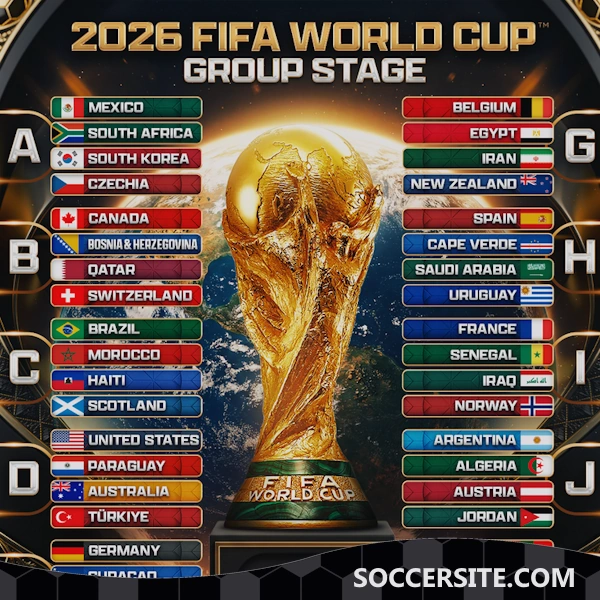
The 2026 FIFA World Cup will be the first men’s edition with 48 teams, hosted across the United States, Canada, and Mexico. With the tournament now close enough to judge squads, tactical trends, and recent international results more seriously, the debate over the true favorites has sharpened. France sit top of the latest FIFA men’s ranking released on 1 April 2026, with Spain second and Argentina third, while Portugal have added a 2025 UEFA Nations League title and England remain fourth in the world rankings. That does not guarantee anything in knockout football, but it gives a strong framework for identifying the teams most likely to go deep and ultimately lift the trophy.
This ranking is not just about reputation. It weighs current ranking strength, tactical identity, depth, balance between attack and control, and whether a team has recently shown it can survive elite-level knockout pressure. On that basis, here are the five national teams with the best chance to win the 2026 World Cup right now in our predictions.
1. France
France start as the narrow number one because they currently lead the FIFA world ranking and remain one of the most complete tournament squads in international football. FIFA’s April 2026 update put them back at the top for the first time since September 2018, ahead of both Spain and Argentina. That matters because France are not relying on one tactical route to win. They can play vertically, counter at speed, or control matches through midfield balance and physical superiority.
The biggest reason France top this list is depth. They can absorb injuries better than almost anyone, and in a World Cup that often decides itself in the last 20 minutes of quarter-finals and semi-finals, that bench value is enormous. Their forward line can destroy teams in transition, their central defenders are used to defending high-level pressure, and their midfield profile gives them enough athleticism to survive against technical opponents and enough technique to hurt pressing sides. France also showed in the 2025 Nations League finals that even in defeat, they can go toe to toe with elite opposition, losing 5-4 to Spain in the semi-finals before beating Germany 2-0 in the third-place match.
The only real concern is that France can sometimes look slightly less cohesive than Spain or Argentina when forced to dominate possession for long stretches. But in World Cup football, adaptability is often more valuable than purity. France have the highest floor and one of the highest ceilings. That is why they sit first.
2. Spain
Spain are second, and the gap to France is extremely small. FIFA specifically described them as the reigning European champions in its April 2026 ranking release, and they spent months at number one before dropping to second after a draw with Egypt. They also reached the 2025 UEFA Nations League final, where they pushed Portugal all the way before losing on penalties. That combination of ranking strength and deep tournament performance is exactly what you want to see from a serious World Cup contender.
The case for Spain is tactical. They may be the best control team in the world right now. Their midfield structure allows them to dominate territory, retain the ball under pressure, and immediately counter-press after losing it. Unlike older Spain sides that were sometimes accused of sterile domination, this version has become much more direct in the final third. They create overloads in the half-spaces, use intelligent fullback movement, and attack cut-back zones more aggressively than before. That makes them much harder to defend over 90 minutes.
Spain also have a strong World Cup-specific profile. Teams that can control tempo usually reduce the randomness of matches, and that is vital in knockout rounds. Their risk, however, is familiar: when facing deep, compact defenses, they still need ruthless finishing. If they solve that consistently during the tournament, they could easily end up winning it all. In pure collective structure, they may be the strongest team in the field.
3. Argentina
Argentina are impossible to place any lower than third. They are the reigning world champions, won the 2024 Copa América by beating Colombia in the final, and finished top of the CONMEBOL qualifying standings overview published by FIFA. Even though they slipped to third in the latest FIFA ranking, their recent body of work still makes them one of the most credible title candidates in the tournament.
What separates Argentina from many elite teams is their comfort in ugly matches. They know how to defend a lead, slow a game, survive momentum swings, and weaponize set-pieces and emotional control. Tournament football is often less about producing perfect football and more about handling imperfect moments, and Argentina have repeatedly shown they can do that better than almost anyone. Their 2024 Copa América title reinforced that identity, and their continued strength in South American qualifying suggests they have not slipped into post-title complacency.
The question is not whether Argentina can win a World Cup, because they already have. The question is whether they still have enough top-end energy and attacking sharpness to beat the deepest European squads over multiple knockout rounds. Even so, no opponent will want to face a side with this much tournament know-how and defensive resilience.
4. England
England deserve fourth place because they currently sit fourth in the FIFA rankings, giving them the strongest numerical case after France, Spain, and Argentina. Their talent level is obvious, but the more persuasive argument is squad profile. England can attack through width, through central combinations, or through early service into a striker who can both finish and connect play. That variety is valuable in a World Cup, where opponents can vary wildly from game to game.
England also have a balanced age curve. There is enough experience to handle pressure and enough young energy to push the tempo late in matches. In recent tournaments, they have looked more tactically mature than older England teams, especially in their use of structure behind the ball and their ability to create danger from set-pieces. That makes them harder to knock out than critics sometimes admit.
The hesitation is psychological and practical rather than technical. England still need to prove they can consistently deliver against the very best teams in the final stages. A recent friendly defeat to Japan was a reminder that talent alone does not guarantee fluency or control. Still, if the attacking stars click at the right time, England absolutely have the tools to win the competition.
5. Portugal
Portugal round out the top five, and they may be the most dangerous side in the tournament if momentum matters most. UEFA’s official records show they won the 2024-25 Nations League, beating Germany in the semi-final and then defeating Spain on penalties in the final. That was not a soft route. It was a genuine demonstration that Portugal can beat top-tier opposition under tournament conditions.
Their squad is loaded with technical quality, especially in midfield and advanced wide areas. UEFA’s own profile of the Nations League winners highlighted tactical versatility under Roberto Martínez, with Portugal able to play different shapes and vary their front-three profile depending on the match. That kind of flexibility is gold in a World Cup. It allows Portugal to lean into control against weaker teams and pace plus directness against stronger ones.
Why are they fifth instead of higher? Mostly because their margin for error is slightly thinner than the top three, and because their performances can still swing between brilliant and uneven. But if their midfield dominates possession and their creators hit form at the same time, Portugal are good enough to beat anyone. Their 2025 Nations League title proved that.
Just Outside the Top Five
Brazil are the biggest omission from the top five. FIFA’s April 2026 update has them sixth in the world, just behind Portugal, and they have still qualified comfortably from South America. On pure player talent, they could easily make a title case. But compared with the five teams above, they arrive with slightly more uncertainty about collective balance and match control against elite opponents. They are close enough that a strong first two matches could make this ranking look too low very quickly.
Final Verdict
If the World Cup started tomorrow, France would be the most logical pick because they combine top ranking status, squad depth, elite athleticism, and multiple tactical routes to victory. Spain look like the best pure team structure. Argentina remain the most battle-tested knockout side. England have one of the strongest overall player pools. Portugal have the freshest elite tournament win of the group. That is why the top five, in order, are France, Spain, Argentina, England, and Portugal.
The most important point is this: there is no overwhelming favorite. The 2026 World Cup looks set to be decided by details, depth, and who handles pressure best in the last two rounds. Right now, these five teams look best equipped for that challenge.